Music at Christ Lutheran Church
Our Pipe Organs
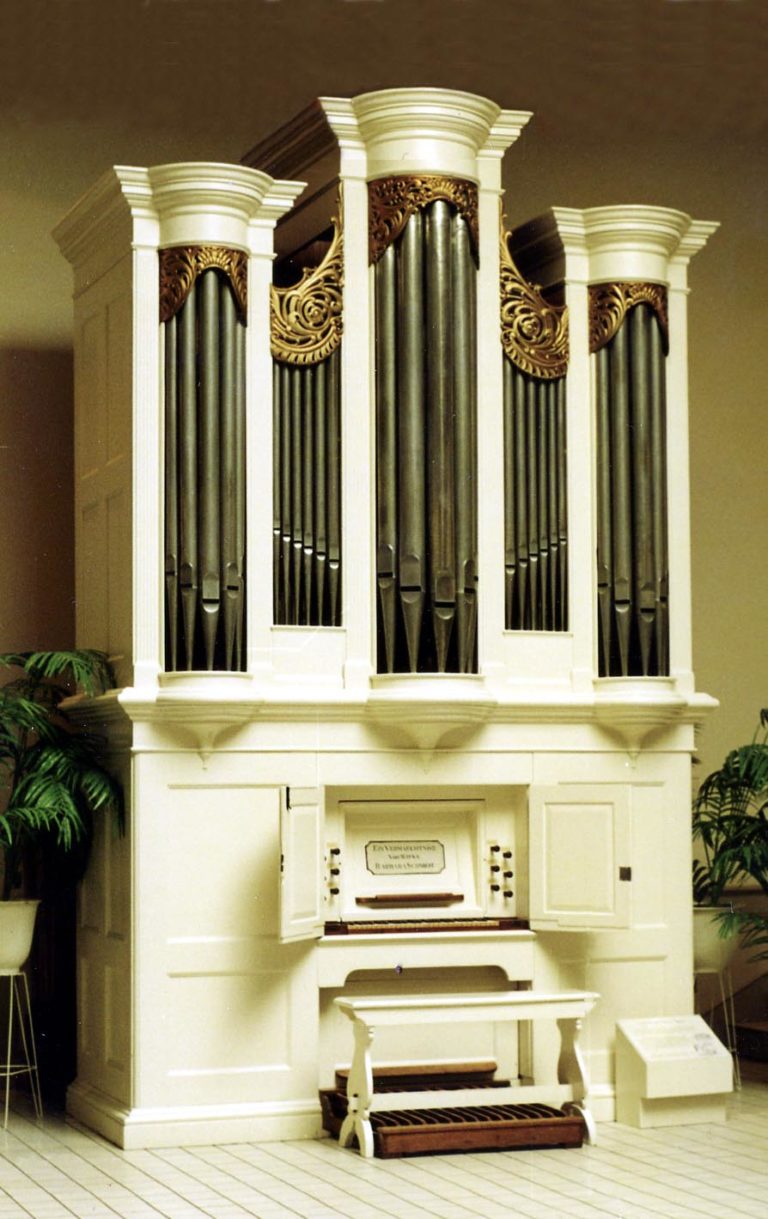
Christ Lutheran Church has a unique place in the history of American organs. Barbara Schmidt, a member of the congregation in the 18th century, left in her will a bequest stating ”that part of the money arising from the sale of my Estate be applied as follows: part thereof towards purchasing an organ for said Congregation.” Sometime after her death in 1798 and before 1803, the congregation commissioned David Tannenberg, a famous American organ builder from Lititz, Pennsylvania, to build the organ specified in the widow’s will—one of only thirty-five he ever made. This organ was eventually retired from use and donated to the York County Historical Society, where you can still see it!
In 1880, the congregation contracted an organ to be built by Derrick Felgemacher of Erie, Pennsylvania. This instrument was installed in divided chambers to the right and the left of the chancel. In 1926 the Möller Company rebuilt and refurbished it with the inclusion of new wind chests and a new console.
In the fall of 1968, the Möller Company recommended an entirely new instrument to be placed in the gallery, as the liturgically and historically correct position for the choir and organ, as well as being ideal for sound projection. During the spring and summer of 1969, a plan was developed to encase the entire instrument in order to ensure a cohesive ensemble sound. A special encased division, called a Rückpositiv, was to be placed on the gallery rail, which would provide special support for the congregation located below. The design of the Rückpositiv was inspired by the case of the original Tannenberg organ.
The new organ reflects the renaissance in American organ building. It follows the Werkprinzipal specification design in that the principal pitches are placed on the 16’ level in the pedal; the 8’ level in the Great; the 4’ level in the Rückpositiv; and the 2’ level in the Swell, allowing the tiered effect and clarity of line so necessary for polyphonic music. The organ is totally unenclosed with the exception of the expressive Swell which is fitted with shades that open a full ninety degrees allowing for maximum egress of sound. This is the first instrument in central Pennsylvania to adhere to these strict principles of organ building first expressed following the Reformation in North Germany. The organ was dedicated in 1971.
Opus 10681
GREAT ORGAN RŰCKPOSITIV
UNENCLOSED UNENCLOSED
Prinzipal 8’ 61 Pipes Holzgedackt 8’ 61 Pipes
Bordun 8’ 61 Pipes Prinzipal 4’ 61 Pipes
Oktave 4’ 61 Pipes Blockflöte 2’ 61 Pipes
Weitprinzipal 2’ 61 Pipes Quinte 1 – 1/3’ 61 Pipes
Mixtur (1-1/3’) IV Ranks 244 Pipes Zimbel (1/2’) III Ranks 183 Pipes
Trompete 8’ 61 Pipes Krummhorn 8’ 61 Pipes
Tremulant
SWELL ORGAN PEDAL ORGAN
EXPRESSIVE
Rohrbordun 16’ 12 Pipes Prinzipal 16’ 32 Pipes
Rohrflöte 8’ 61 Pipes Rohrbordun 16’ 12 Pipes
Gemshorn 8’ 61 Pipes Oktav 8’ 32 Pipes
Gemshorn Celeste (T.C.) 8’ 49 Pipes Rohrflöte (Sw) 8’ 12 Pipes
Spitzflöte 4’ 61 Pipes Choralbass 4’ 32 Pipes
Prinzipal 2’ 61 Pipes Rauschquinte (2 – 2/3’) II Ranks 64 Pipes
Sesquialtera (2 – 2/3’) II Ranks 98 Pipes Aculta (1 – 1/3’) II Ranks 24 Pipes
Scharf (1’) III Ranks 183 Pipes Posaune 16’ 32 Pipes
Trompette 8’ 61 Pipes Krummhorn (Pos.) 4’
Schalmei 4’ 61 Pipes
Tremulant
ACCESSORIES COUPLERS
Pistons No. 1-6 affecting Great Great to Pedal
Pistons No. 1-6 affecting Swell Swell to Pedal
Pistons No. 1-6 affecting Positiv Positiv to Pedal
Pistons No. 1-12 affecting full organ (duplicated by toe studs) Swell to Great 16’
Toe Studs No. 1-2-3-4 affecting Pedal Swell to Great 8’
General Cancel Positiv to Great
Sforzanado (duplicated by toe stud) Swell to Positiv
Balanced Crescendo Pedal Swell to Swell 16’
Zymbelstern Unison off (Sw.)
99 levels of memory Swell to Swell 4’